

Many dentists only notice a problem when their dental low speed handpiece starts making noise, losing power, or vibrating uncomfortably in their hand. But what they do not see is the real culprit hiding deep inside the metal shell: the transmission shaft. In any slow speed dental handpiece, this shaft is responsible for transferring rotational energy from the motor to the bur or prophy cup. When it bends, rusts, or wears out, the entire slow speed handpiece feels weak and unreliable. Worse still, a damaged shaft can cause eccentric rotation, leading to poor cutting efficiency, overheated handpiece bodies, and even patient discomfort. XunTeng repair services focus precisely on this overlooked but mission-critical component. Whether you use a slow speed prophy handpiece for routine polishing or a WBX dental handpiece for complex restorative work, the quality of the shaft determines your clinical success. Instead of throwing away an expensive handpiece, a simple shaft replacement can restore it to like-new condition at a fraction of the cost. XunTeng stocks every major shaft type: straight shafts, left-right reciprocating shafts, mini push-button shafts, N-type, K-type, and even 20:1 implantology shafts. No matter which slow speed handpiece you bring us, we have the exact match.
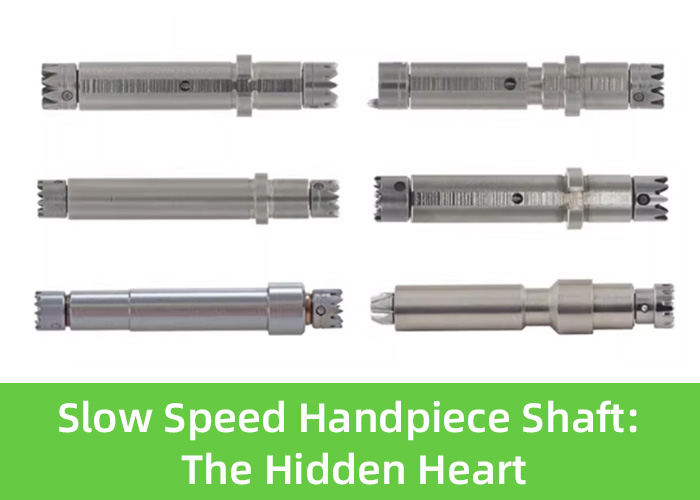
Let us look at the most common failure scenarios in a busy dental clinic. The dental low speed handpiece used for chairside polishing runs for hours every day. Over time, the shaft inside your slow speed prophy handpiece accumulates microscopic wear, especially if autoclave sterilization moisture seeps past the seals. The result is a telltale "chattering" sensation during polishing — something patients can feel as an unpleasant vibration on their teeth. For endodontic procedures, the slow speed dental handpiece must deliver smooth, concentric rotation to avoid breaking delicate files. A bent shaft makes precise root canal preparation nearly impossible. In surgical settings, the WBX dental handpiece demands even higher precision, particularly the 20:1 reduction shaft for implant osteotomy preparation. Any runout or backlash can compromise implant site preparation. XunTeng understands that different clinical tasks require different shaft characteristics. That is why we offer left-right reciprocating shafts for heavy-duty trimming, mini push-button shafts for pediatric or posterior access, and N/K-type shafts to match various brand interfaces. When your slow speed handpiece feels "off," do not guess — let XunTeng diagnose the shaft first. Nine times out of ten, that is where the problem lives.
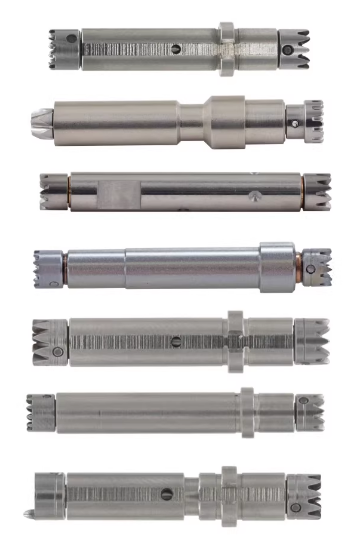
Now let us talk about the specific shaft types available through XunTeng repair services, because not all dental low speed handpiece shafts are interchangeable. First, the standard transmission shaft works with most conventional slow speed handpiece models for general restorative work, prophylaxis, and model trimming. Second, the left-right reciprocating shaft is engineered for oscillating motion, reducing fatigue fractures during heavy intermittent cutting. Third, the mini push-button shaft is designed for compact, low-profile handpieces used in pediatric dentistry or difficult-access posterior regions — the push-button mechanism allows one-second bur changes. Fourth, the N-type push-button shaft and K-type push-button shaft are precisely dimensioned to fit specific brand families such as NSK, W&H, and Bien-Air. Using the wrong shaft leads to excessive play, noise, and premature failure. Finally, the 20:1 implant shaft is a completely different category. It contains a planetary gear train that reduces input speed by a factor of 20 while multiplying torque dramatically. This slow speed dental handpiece shaft must maintain absolute concentricity; even 0.02mm of runout is unacceptable for implant surgery. XunTeng stocks every one of these shafts, tested on dynamic balancing equipment. For clinics running multiple WBX dental handpiece units or mixed-brand slow speed handpiece inventories, XunTeng provides a simple identification and replacement service — no more guessing games.
Why choose XunTeng over buying a brand-new slow speed handpiece? The economics are compelling. A premium dental low speed handpiece can cost several hundred dollars or more. Replacing a transmission shaft typically costs less than one-third of that. More importantly, XunTeng repairs are not limited to one or two brands. We support all major manufacturers. Have a WBX dental handpiece with a seized shaft? We have the part. An older slow speed prophy handpiece that no longer spins smoothly? We can restore it. A slow speed dental handpiece from an obscure European brand? Send it in. Our technicians have decades of combined experience and maintain an extensive cross-reference database of shaft dimensions: overall length, gear diameter, spline count, bearing spacing, and thread type. Every repaired slow speed handpiece undergoes a post-repair validation test measuring RPM stability, noise level (dB), and radial runout. Only when it meets or exceeds factory specifications does XunTeng return it to you. And the service does not end there. XunTeng provides a clear warranty period on all replaced shafts. If the same shaft fails under normal use within that period, we replace it at no charge. For busy clinics that cannot afford downtime, XunTeng also offers expedited repair options and loaner handpiece programs. That is what we mean by thoughtful after-sales support — not just fixing a dental low speed handpiece, but keeping your schedule running.
