

In oral restorative treatment, high-speed handpiece burs are indispensable tools for dentists. A well-organized, high-quality bur kit directly impacts tooth preparation quality and clinical efficiency. Diamond abrasive-based high-speed bur kits, known for their superior cutting performance and precise classification, have become a vital clinical asset in modern dentistry.
Material Properties of Diamond Burs
Diamond burs feature natural or synthetic diamond particles attached to a metal substrate through electroplating or sintering processes. These diamond particles offer extremely high hardness and exceptional wear resistance, enabling stable, efficient cutting of tooth structure at high rotational speeds. Unlike conventional steel burs, diamond burs maintain their cutting edges for significantly longer periods, reducing the need for frequent bur changes during procedures. Furthermore, the superior thermal conductivity of diamond materials helps dissipate heat generated during high-speed rotation, thereby reducing the risk of pulpal damage and improving patient comfort during extended preparation procedures.
To meet different clinical needs, professional diamond bur kits typically include various shapes and grit sizes. Each bur shape is specifically engineered for particular tooth preparation tasks. For example, the TF series features a flat end with a right angle and is primarily used for metal-ceramic crown shoulder preparation, where a well-defined marginal geometry is essential for long-term restoration success. The TR series incorporates a rounded end and is specifically designed for all-ceramic crown margin refinement, as the rounded profile reduces stress concentration within the tooth structure, which is particularly critical for zirconia and lithium disilicate restorations. The FO series presents a flame-shaped pointed configuration and works effectively for occlusal surface and anterior tooth preparation, allowing dentists to replicate natural anatomical contours with precision. The TC series features a sharp pointed design and is intended for axial surface preparation, helping clinicians achieve consistent wall angles and prevent undesirable undercuts.
Notably, professional diamond bur kits adopt an internationally recognized color-coding system for grit differentiation, which significantly enhances clinical efficiency by allowing immediate visual identification of cutting aggressiveness. The green label indicates coarse grit, ranging from 125 to 150 micrometers, and is used for rapid caries removal and initial bulk reduction of tooth structure. The blue label represents standard grit, ranging from 106 to 149 micrometers, and is suitable for routine crown and bridge preparations where balanced cutting efficiency and surface smoothness are required. The red label designates fine grit, ranging from 53 to 63 micrometers, and is employed for precise margin refinement and final contouring before impression taking. The yellow label denotes extra-fine grit, ranging from 20 to 30 micrometers, and is used for final polishing-level surface finishing, creating a smooth, glaze-like surface that enhances restoration bonding and marginal integrity.
Notably, professional diamond bur kits adopt an internationally recognized color-coding system for grit differentiation, which significantly enhances clinical efficiency by allowing immediate visual identification of cutting aggressiveness. The green label indicates coarse grit, ranging from 125 to 150 micrometers, and is used for rapid caries removal and initial bulk reduction of tooth structure. The blue label represents standard grit, ranging from 106 to 149 micrometers, and is suitable for routine crown and bridge preparations where balanced cutting efficiency and surface smoothness are required. The red label designates fine grit, ranging from 53 to 63 micrometers, and is employed for precise margin refinement and final contouring before impression taking. The yellow label denotes extra-fine grit, ranging from 20 to 30 micrometers, and is used for final polishing-level surface finishing, creating a smooth, glaze-like surface that enhances restoration bonding and marginal integrity.
Furthermore, the kit utilizes suffix letters to provide additional control over cutting characteristics. Adding the letter "C" after the bur number indicates a specific coating or grit configuration. Adding the letter "F" signifies fine grit within the red label category. Adding the letters "EF" denotes extra-fine grit within the yellow label category. This systematic nomenclature allows dentists to precisely select the appropriate bur for each sequential stage of tooth preparation, from aggressive initial reduction to delicate final polishing.
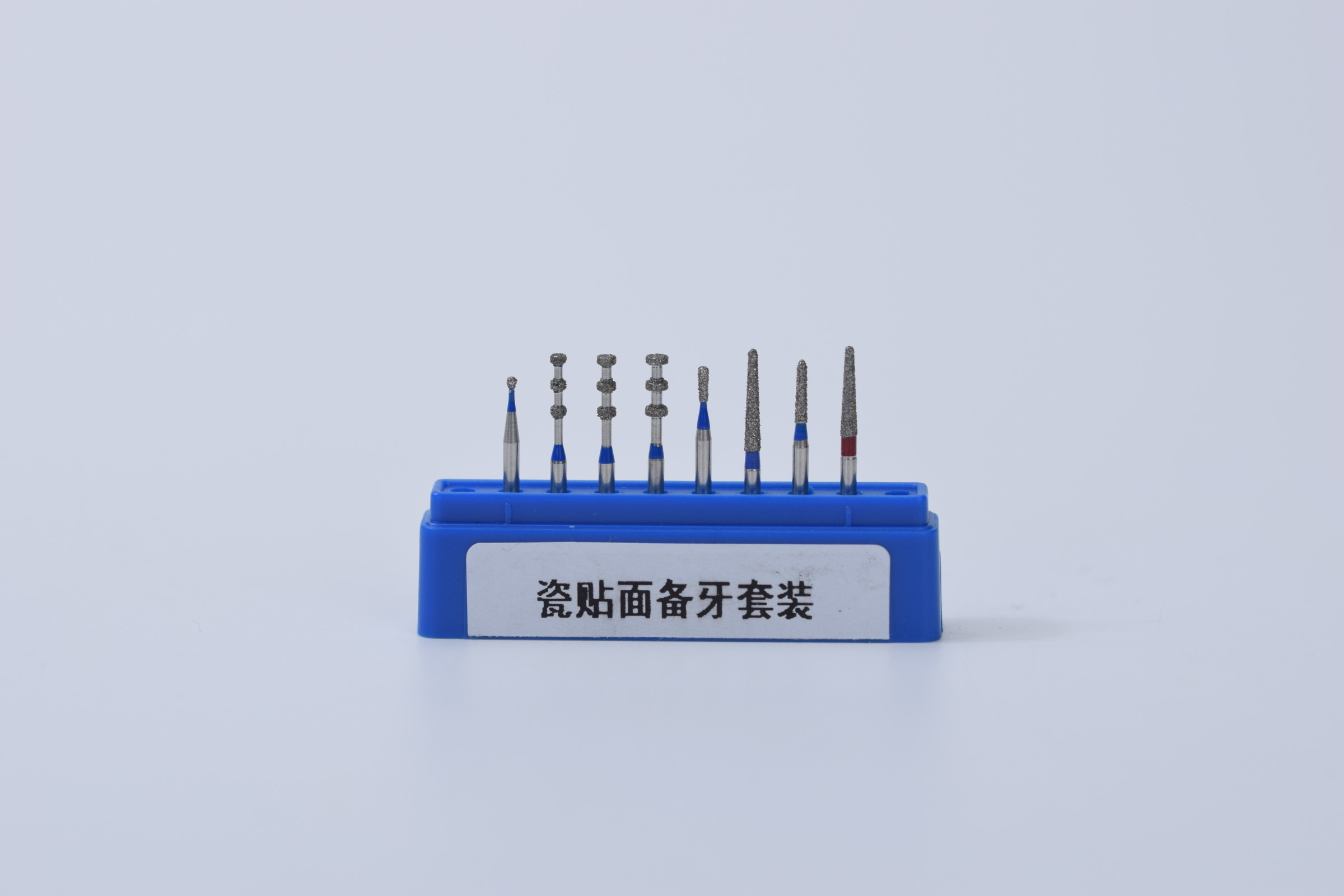
The diamond bur kits from Foshan Xunteng Medical Technology Co., Ltd. cover a wide range of clinical scenarios in restorative dentistry, orthodontics, and pediatric dentistry. For porcelain veneer preparation, specialized kits include fine and extra-fine burs that enable controlled enamel reduction with minimal surface roughness, which is essential for predictable adhesive bonding. For full-crown preparation on molars, dedicated kits provide coarse and standard grit burs designed for efficient yet controlled reduction of posterior tooth structure. For shoulder margin preparation, combination kits offer a selection of TF and TR series burs in various grit sizes to accommodate both metal-ceramic and all-ceramic restorative materials. For interproximal reduction, specialized kits include thin-profile burs that safely create space between adjacent teeth for orthodontic treatment or restorative access. For pediatric applications, dedicated kits feature smaller head sizes and rounded tips to enhance safety and control when treating primary dentition. For polishing and fine grinding, extra-fine grit kits allow clinicians to achieve clinically smooth surfaces that resist plaque accumulation and optimize restoration fit.
A complete, standardized diamond bur kit not only improves the repeatability and precision of dental operations but also represents the broader trend of dental instruments moving toward specialization and systematization. When every bur has a designated purpose and every clinical stage has a corresponding instrument, the predictability of treatment outcomes increases substantially. Dental professionals who invest in high-quality, well-organized diamond bur kits benefit from reduced procedure times, enhanced patient comfort, and consistently superior restorative results. Choosing a high-speed bur kit made of diamond abrasive material means choosing efficiency, safety, and quality for both the clinician and the patient.
